
Long-form Market Insight Private Label Customization
Body Trimmer Spare Parts and After-Sales Planning for OEM Buyers
For OEM buyers, body trimmer spare parts planning is a product planning and complaint control decision, not just an after-sales topic. The right sample evaluation, accessory set, packaging, and RFQ scope help private label teams keep the sold version clear and reduce confusion after launch.
Planning an OEM project? Submit RFQ
Start with the customer decision behind body trimmer spare parts and after-sales planning
A useful OEM discussion starts with the channel problem, not the spare part itself. Distributors, private label teams, and marketplace brands need to know whether the sold body trimmer system will remain understandable after the first shipment, because the support burden usually begins when packaging, inserts, and replacement-item expectations do not match the item in the box.
For that reason, the buyer should define the product position before defining the spare parts list. Is the project a value SKU with only the essential consumables and accessories, or a more complete private label system where replacement heads, guards, or other compatible items are expected to be part of the offer? That decision changes how the product is presented, how the manual is written, and which points must be reviewed during sample evaluation.
Market context and limits
Use market information to frame a decision, not to make one for the project
2026 Q1 U.S. e-commerce context. This is not a body-trimmer demand forecast or AIMEI customer data.
U.S. Census Bureau: Quarterly Retail E-Commerce Sales ↗Context for the need to support objective advertising claims before they are made. It is not market-specific legal advice.
FTC: Policy Statement Regarding Advertising Substantiation ↗Context for product presentation, labelling, warnings and safety information in EU-facing programmes.
European Commission: General Product Safety context ↗Translate the consumer moment into a buyer brief, not a longer feature list
The brief should convert the market question into a controlled project document. For body trimmer spare parts planning, the buyer should identify which components are fixed in the sold version, which accessory items are optional, and which items are only references for future expansion. This avoids a common sourcing problem: teams talk about one general product family, but the actual SKU, accessory set, and packaging configuration are not yet aligned.
A practical buyer brief also separates physical configuration from communication scope. The product itself may be one version, while packaging layout, user instruction planning, and replacement-part references may be handled differently by channel. If that separation is not written down early, the RFQ becomes vague and the factory may quote against assumptions that do not match the retail or importer requirement.

For the next decision in this project, read Private Label Body Trimmer Launch Checklist for OEM Buyers.
Use the sample to review the whole product system
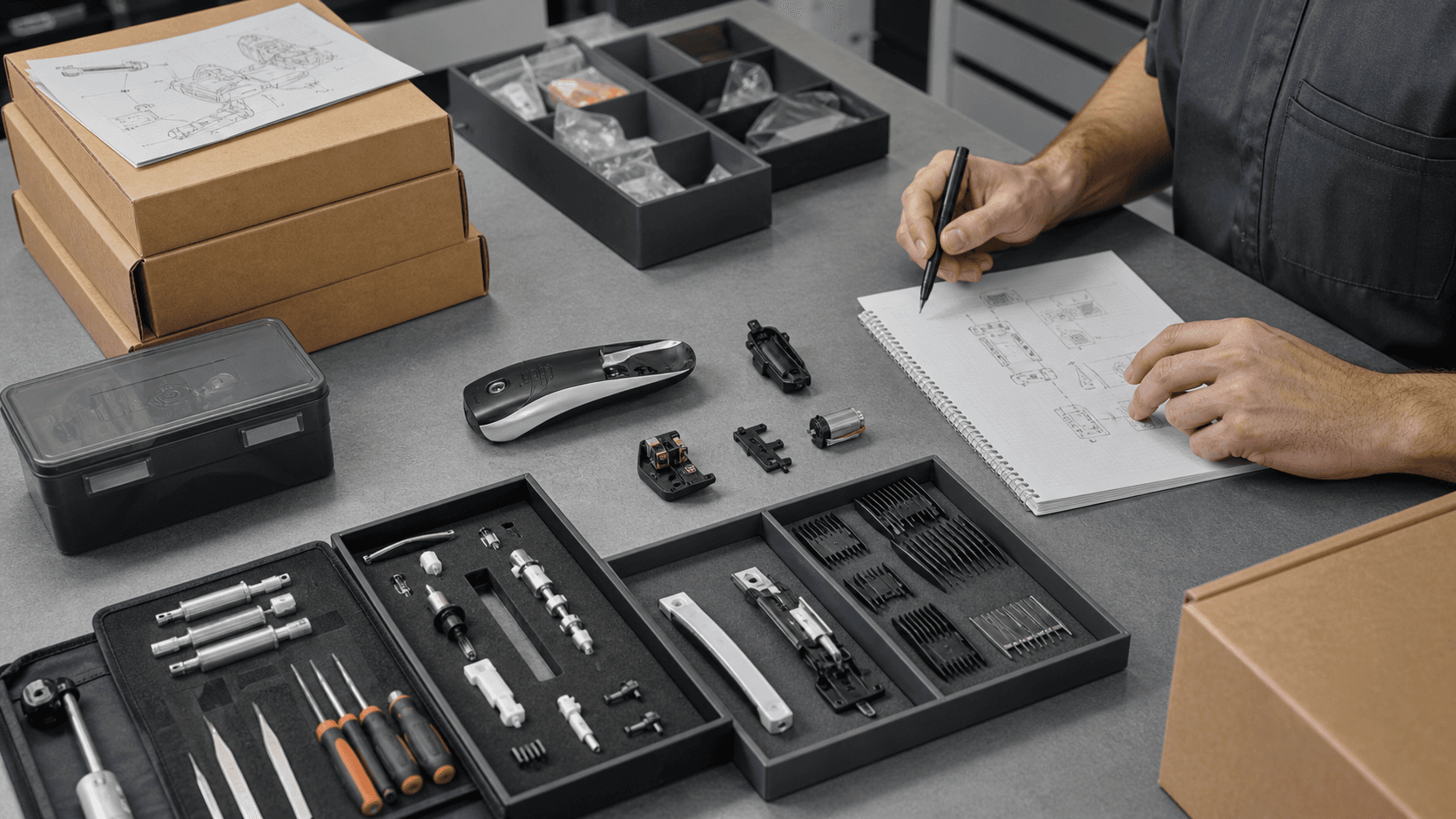
A sample should be reviewed as a complete sellable system, not only as a functional device. For a body trimmer project, that means checking the named sample version together with the accessory set, spare-part compatibility, packaging presentation, and the way the manual explains what is included and what is not.
This is the stage where buyers can catch avoidable confusion. For example, if the sample looks like it supports a replacement head or guard but the packaging does not clearly show that relationship, the future customer may not understand what belongs to the SKU. Sample evaluation should therefore answer three questions: what the buyer sees, what the end user expects, and what the supplier is actually committing to produce.
Control claims, packaging and instructions before they become separate stories
Packaging, claim language, and instructions should be reviewed together because they create one commercial promise. A body trimmer box image, icon, or accessory callout can create an expectation that must match the released version. If the project uses any objective statement about replacement parts, compatibility, or included items, the buyer should confirm that the wording matches the exact sample and the exact SKU version.
This is also where claim boundaries matter. A source note or product sheet can support planning, but it should not be treated as a finished market claim unless the project has the proper internal basis for it. The safest approach is to keep the packaging text, manual wording, and product specification sheet synchronized before artwork release. That reduces after-sales complaints caused by unclear inclusions, vague compatibility language, or packaging that overstates what the buyer has approved.
To compare this topic against a real manufacturing route, see the AIMEI Body Trimmer OEM Platform.
Turn the article into a better RFQ and project decision
The RFQ should make the project decision visible, not just request a quotation. For body trimmer spare parts planning, include the target market, sales channel, intended product position, accessory set, packaging scope, manual scope, and any unresolved compatibility questions. If the project may expand into multiple SKUs, say which version is being sampled first and which elements are still open.
A strong RFQ helps the supplier respond in a way that supports mass production readiness. It tells the factory what must be fixed for the first release, what can remain optional, and what needs review during sample confirmation. That makes the next discussion more precise: which platform route is suitable, which spare parts should be bundled or referenced, and which packaging and instruction details must be locked before the item is presented to the channel.
Buyer checklist before RFQ
- State the target customer, use situation, and sales channel before comparing features.
- Mark each product, pack, and information decision as fixed, preferred, or still open.
- Review the named sample, accessory set, packaging, and instructions as one product system.
- Link every objective consumer-facing claim to the correct version and its supporting record.
- Bring unresolved market, commercial, and production questions into the RFQ.
FAQ
Can this article replace a project-specific compliance review?
No. It is a planning framework for OEM and private label projects. Market, product, packaging, and documentation decisions still need to be checked against the confirmed project requirements and the buyer’s own release process.
What should be included in the first RFQ?
Include the target market, channel, intended product position, accessory set, packaging scope, manual scope, any replacement-part expectations, and any open questions about compatibility or claim wording. The RFQ should also state which sample version is being referenced.
Can AIMEI recommend an existing product platform?
AIMEI can discuss available body trimmer platform directions against the buyer brief and the required accessory or packaging scope. Final feasibility and configuration should be confirmed through the RFQ, sample evaluation, and project review.
Continue the OEM decision path
Ready to turn this requirement into a product brief? Submit RFQ